
Jungian interpretation
The warrior, the shadow and the choice: a Jungian reading of an image
Use a shield, an open hand and a visible tension to explore one Jungian question, without diagnosing the viewer or turning a theory into a universal key.
In The Warrior’s Choice, strength is expressed through a boundary and an offered hand. The scene can be read as a conflict between protection and contact. A Jungian lens opens another question: what response am I unwilling to recognize in myself?
This is an interpretation of fictional art. Neither the character nor the viewer is being diagnosed, and the video was not a clinical experiment.
What “shadow” means in this discussion
In Natalia Serebrennikova’s account for the International Association of Analytical Psychology, shadow includes aspects of personality excluded from the conscious self-image; these may include valued capacities as well as troubling traits. The account also discusses encounters with shadow through reactions to art and stories. IAAP, The Shadow.
That gives us a theoretical lens, not a decoding device. An angry figure is not automatically “the shadow,” and a dark costume does not prove moral darkness. We should first describe the action and consider alternatives.
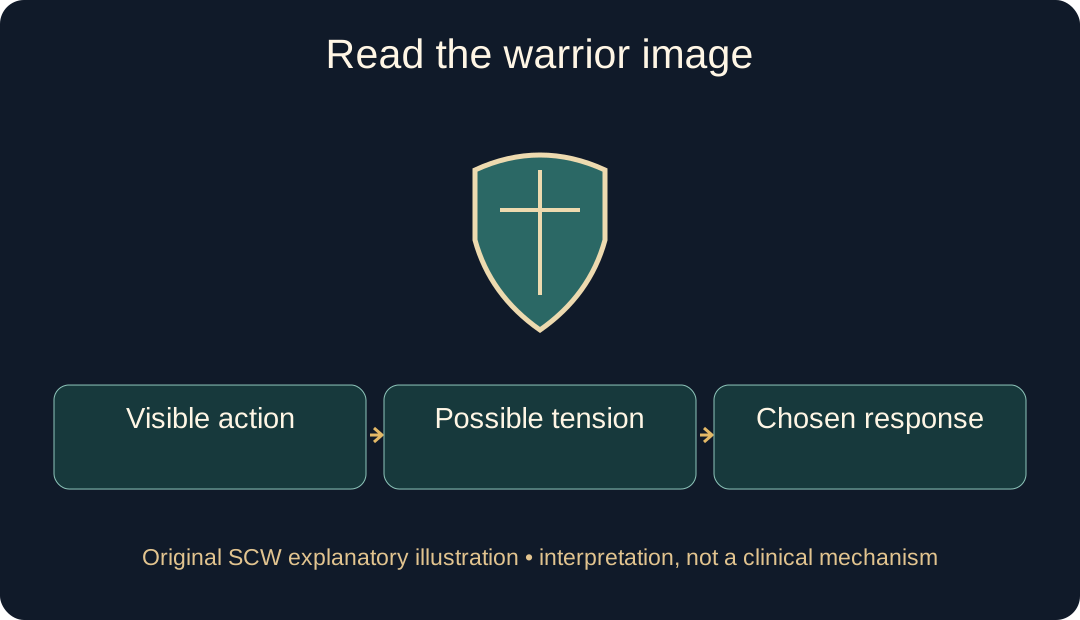
Read the art in three passes
First, look at the composition. Where is the shield? Is the hand open or closed? How far apart are the figures? Those visible choices can make protection, distance or invitation legible before a narrator explains them.
Then, propose a tension. The shield might suggest a necessary boundary. It might also suggest fear of contact. The open hand could suggest generosity, a cautious offer or vulnerability. Hold more than one reading until the sequence gives you more context.
Finally, ask what the reading changes. Instead of trying to become “the warrior archetype,” choose one response you can name. A boundary can be firm while an offer remains optional.
The question is not whether the image proves Jung right. It is whether this lens makes the scene more intelligible while leaving room for other readings.
A concrete example: firmness without contempt
Imagine a request you cannot accept. You recognize irritation and the wish to be seen as endlessly helpful. A possible response is: “I cannot do this today. I can discuss a smaller version tomorrow.”
The shield represents the limit in this editorial example; the hand represents an optional alternative. Recognizing anger does not require acting it out. It also does not require excusing someone else’s harmful behavior.
In The Healer in the Hurricane, use the same method with the actual objects in the video. A shield, spear or journal should receive a distinct explanatory role; they should not become decorative “spiritual” props.
A Jungian book and an art example to explore
Man and His Symbols is a multi-author introduction associated with Jung and his collaborators. The publisher’s record confirms the work; it is offered as further reading, not as a substitute for checking a particular chapter or page. We have not invented a quotation from it.
The IAAP essay illustrates its discussion with the historical “Black Sun” image from Viridarium chymicum (1624), as captioned there. Consider how a dark central form organizes attention. Our response to that contrast is an exercise in looking; a black circle alone does not establish a diagnosis, a cultural identity or the artist’s private intention.
Limits and references
- Natalia Serebrennikova, The Shadow, IAAP: a specialist interpretation within analytical psychology, including the captioned art example.
- Penguin Random House, Man and His Symbols: bibliographic further reading; no claim of having consulted every chapter.
Sources checked 15 October 2026. The SCW shield/hand reading, diagram and scenario are original applications of a Jungian lens. They are not an Indigenous teaching, a Taoist doctrine or a validated treatment.